Specialised vestibular assessment, with care that extends from diagnosis to treatment.

Dizziness and balance problems are disorienting in every sense. They affect how you move through the world and how confident you feel doing ordinary things – walking down stairs, driving, even turning your head too quickly. And they’re often difficult to explain, which makes them even harder to get answers about.
A vestibular assessment at Knox Audiology identifies exactly where in your balance system things aren’t working as they should. For clients who need ongoing support, vestibular physiotherapy is available in-house at Wantirna, so you can move from diagnosis to recovery without being sent elsewhere.
Call 03 9800 5697 to book an assessment
Balance and dizziness symptoms are notoriously hard to describe, and they often go unexplained for a long time. If any of this feels familiar, a vestibular assessment may help.
You don’t need to tick every box. If dizziness and balance problems are affecting your day-to-day life, that’s reason enough to get checked.

“We are absolutely thankful and pleased with Luke’s services! He has been a very dedicated , caring and understanding audiologist to my mum. He is passionate about his work and I would strongly recommend him to anyone!”
All Knox audiologists hold a Master's in Clinical Audiology and are accredited members of Audiology Australia (AAudA).
Specialist diagnostic technology used by experienced clinicians at Wantirna and Surrey Hills clinics.
Knox Audiology has been caring for hearing and balance health in Melbourne's eastern suburbs since the mid-1990s.
Balance relies on your inner ear, your eyes and your body all working together. When something in that system is disrupted, the result can be dizziness, vertigo, unsteadiness or a spinning sensation. Because your hearing and balance organs sit side by side in the inner ear, some tests also check how sound and nerve signals are processing. Your assessment is designed to work out exactly which part of the system is involved, so any treatment can be targeted rather than guesswork.
A conversation about your symptoms and medical history, to guide the rest of the assessment.
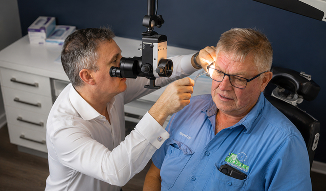
Tracks eye movement to see how your inner ear and brain are communicating.
Checks for and treats the most common cause of vertigo, often resolved in the same appointment.
Uses warm and cool stimulus to test how each ear responds, and compare one side to the other.
Quick head movements test how each part of the inner ear responds to fast motion.
Uses sound to test a different part of the inner ear balance system.
Checks how sound signals travel from your ear to your brain.
A test used to measure electrical activity of the inner ear, often used to check for conditions like Meniere’s disease.
You’ll need a referral from your GP, ENT or specialist before we can book you in. Once received, we’ll confirm your appointment. Ears must be wax-free beforehand (we can book removal on the same day for an extra charge). Check with your doctor whether it’s safe to pause dizziness-suppressing medication for a few hours before the test.
You can review the type of tests that may be included in your assessment above.
We’ll explain your results in plain language on the day, wherever we can. Some tests need further review after your appointment to confirm a diagnosis, so the full diagnosis and report will follow a short time after your appointment. A written report is sent to your referring practitioner.
If ongoing support is recommended, you can move straight into vestibular physiotherapy on-site at Wantirna.

Wantirna

Wantirna & Surrey Hills

Wantirna
A referral from your GP, ENT or treating specialist is required before booking a vestibular assessment. If you haven’t seen anyone about your symptoms yet, your GP is the best place to start, ask them for a referral to Knox Audiology for specialist assessment.
A Medicare rebate may apply to vestibular assessments with a valid referral, depending on the specific tests performed and your individual eligibility. Your audiologist will confirm exactly what applies when your appointment is booked.
A vestibular assessment is a series of specialist tests that examine how the inner ear, eyes and brain work together to control balance. It's used to identify the cause of dizziness, vertigo or balance problems and to guide the right treatment pathway. At Knox Audiology, vestibular assessments are available at Wantirna and Surrey Hills, performed by specialist audiologists using dedicated diagnostic equipment.
Vertigo is a specific sensation of spinning or movement, either of yourself or the room around you, and is often caused by a problem in the inner ear. Dizziness is a broader term that includes light-headedness, unsteadiness or a feeling of being off-balance, which can have inner ear, neurological or cardiovascular causes. A vestibular assessment helps clarify which type you're experiencing and what's causing it.
Common signs include recurring dizziness or vertigo, unsteadiness when walking, difficulty focusing in busy environments, and nausea associated with movement or position changes. If your symptoms are affecting your daily life and haven't been clearly explained, a vestibular assessment is the appropriate next step. A referral from your GP, ENT or specialist is required before booking.
Yes. A referral from your GP, ENT or treating specialist is required before booking a vestibular assessment at Knox Audiology. If you haven't yet seen anyone about your symptoms, your GP is the recommended first step, and can also advise on Medicare rebate eligibility.
Dizziness and vertigo are caused by disruption to the balance system, which relies on signals from the inner ear, eyes and body. Common causes include benign paroxysmal positional vertigo (BPPV), Menière's disease, vestibular neuritis and inner ear infections, and less commonly, neurological or cardiovascular factors. A vestibular assessment identifies which part of the system is involved.
BPPV (benign paroxysmal positional vertigo) is the most common cause of vertigo, and occurs when small calcium crystals in the inner ear move out of position. It causes brief but intense spinning, usually triggered by head movement such as rolling over in bed or looking up. BPPV is typically identified and treated in a single appointment using a repositioning procedure, often with immediate relief.
Yes. Most vestibular conditions are managed without surgery. Treatment options include repositioning procedures for BPPV, vestibular rehabilitation physiotherapy, medication and lifestyle adjustments. At Knox Audiology Wantirna, in-house vestibular physiotherapy means you can begin treatment directly after your assessment, without needing a separate referral or a new practice.
Results are explained on the day in plain language, and a written report is sent to you and your referring practitioner within a week. Where ongoing treatment is recommended, clients at Wantirna can move directly into vestibular physiotherapy within Knox Audiology, keeping continuity of care under the same clinical team.
A Medicare rebate may apply for vestibular assessments when you have a valid referral from a GP or specialist. The rebate amount depends on the specific tests performed and your individual eligibility. Your audiologist will confirm what applies at the time of booking.
Knox Audiology offers vestibular assessment at two locations in Melbourne's east: Wantirna (230 Mountain Highway) and Surrey Hills (203 Union Road). In-house vestibular physiotherapy is available at Wantirna. A referral from your GP, ENT or specialist is required before booking at either location.
Knox Audiology offers the full vestibular care pathway, from specialist assessment to in-house treatment, under one roof in Melbourne’s east.