Specialist Auditory Processing Disorder assessments for children and adults, by accredited audiologists across four Melbourne clinics.
Sometimes it isn’t distraction, It’s the story someone starts believing. A child who hears fine but struggles to process what’s said can look distracted, or badly behaved, or simply not that clever. Teachers notice it. Parents worry about it. And often, the child starts believing it too. I’m not clever. I’m naughty. I can’t concentrate. Adults carry a version of this too, struggling to follow conversations or filter out background noise, and quietly wondering if something’s wrong with them.
Auditory Processing Disorder (APD) affects how the brain makes sense of sound, not how well you hear it. Often, the real problem isn’t intelligence, effort or behaviour at all, it’s that gap. Knox Audiology’s specialist APD team offers screening, assessment and therapy for children and adults who find it hard to follow conversations, filter out background noise or process spoken instructions. With more than 30 years of specialist hearing care in Melbourne’s east, we take a whole-person approach: your audiologist explains results in plain language, recommends a suitable therapy pathway and, where helpful, prepares practical support letters for teachers, coaches or employers. An APD assessment looks at that gap directly, so you or your child gets an answer instead of a label.

“Sometimes it isn’t distraction, It’s the story someone starts believing. A child who hears fine but struggles to process what’s said can look distracted, badly behaved, or simply not that clever. Teachers notice it. Parents worry about it. And often, the child starts believing it too.”

“If you have children, Knox Audiology in Boronia is great. We have seen Renee twice and she is FABULOUS. Gentle, kind, and fun”
If your child seems to hear fine at home but struggles to follow instructions at school, loses track of conversations in noisy rooms, or needs things repeated more than other children, there is usually a reason for it. Have you noticed any of these?
APD screening is available from 3.5 years, with full APD assessment from 7 years. If you have concerns, it’s worth exploring them. An APD assessment is the best way to find out what is happening, and what support may help.
Many adults have spent years, sometimes decades, struggling in meetings, on phone calls or in noisy restaurants without understanding why. If conversations in groups feel harder than one-to-one, or listening feels more exhausting than it should be, APD may be worth exploring.
A diagnosis as an adult is not a setback – it is an explanation. With the right support, things can genuinely improve.

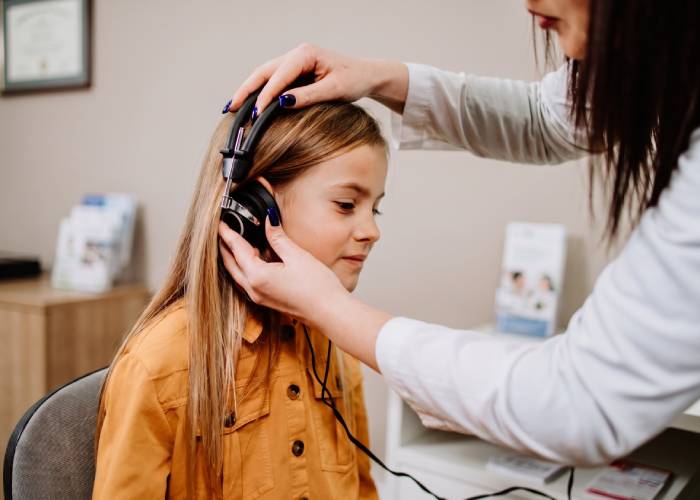
Before your assessment, you’ll have a phone consultation with one of our APD audiologists. This is a chance to talk through your concerns, understand what the assessment involves and complete initial questionnaires. It helps ensure your appointment is focused and nothing feels unexpected.
No two APD assessments look exactly the same. Your audiologist will select the most relevant components based on your individual situation, which may include a hearing assessment and a range of listening and processing tasks. The full assessment typically takes place over one to two appointments, each around 1 to 1.5 hours.
Screening results are explained clearly at the end of your assessment. Full assessment results take a little longer – once your report has been written, we’ll arrange a follow-up telehealth appointment to go through the findings with you in detail.
An assessment is the start of support. Your audiologist will guide you through the next steps, that could be APD therapy, home-based support tools, or a combination of both. This is the beginning of your hearing journey, with support designed to help you stay connected to your world.
Ongoing APD therapy is available at our Wantirna, Doreen and Surrey Hills clinics. Sessions are tailored to the individual, focusing on the specific auditory skills identified during your assessment and building them over time in a structured, supportive way.
Knox Audiology provides home therapy recommendations through app-based tools and practical exercises, giving families clear, achievable ways to support progress between appointments and build skills into everyday life.
For some people, assistive listening devices make a meaningful difference to daily life alongside or between therapy. Your audiologist will let you know which, if any, are relevant for your situation.
APD is not a hearing problem in the traditional sense. The ears work normally. The difficulty is in how the brain processes what the ears hear. A person with APD can pass a standard hearing test and still struggle to follow conversations, understand speech in noisy environments, or make sense of what they are hearing.
APD can look like inattention, learning difficulties or behavioural issues and is often misunderstood. Many families come to Knox audiology after a long journey through other assessments and explanations that have not fully answered their concerns. If something has felt off but nothing has quite explained why, APD is worth exploring.

If you have a referral from a GP, ENT or paediatrician, the hearing test component of the APD assessment may be eligible for a Medicare rebate.
In some cases where a child is being investigated for a complex neurodevelopmental condition, Medicare rebates may apply under specific eligibility criteria. This requires a referral from a GP or paediatrician.

Wantirna

Wantirna & Surrey Hills
Boronia

Wantirna & Boronia

Wantirna & Doreen

Wantirna & Boronia
APD is a condition where the ears work normally but the brain has difficulty processing what it hears. A child or adult with APD can struggle to follow speech, especially in noisy environments, even when a standard hearing test shows normal results. It is a difference in how the brain processes sound, not a hearing loss.
Common signs include asking for repetition, struggling in noisy classrooms, difficulty following instructions and falling behind at school despite normal intelligence. Many children are first thought to be inattentive or have other learning difficulties before APD is considered. If these signs sound familiar, an assessment is the clearest way to understand what is happening.
APD screening is available from 3.5 years, with full APD assessment available from 7 years. Both are conducted by Knox's specialist APD audiologists.
The assessment typically takes one to two appointments, each around 1-1.5 hours each. Before this, there is a phone consultation to discuss concerns and complete initial questionnaires.
You do not need a referral to book an APD assessment at Knox. However, a GP, ENT or paediatrician referral may allow parts of the assessment to be eligible for a Medicare rebate. In some cases involving complex neurodevelopmental concerns in children, specific referral pathways may also apply.
APD assessments may be partially covered by Medicare if you have the appropriate referral, depending on the components being assessed and eligibility criteria. Your audiologist will explain what applies to your situation during your appointment.
Results are explained clearly at the end of your assessment, with a written report provided in the week following. A copy is also sent to your referring practitioner. Where helpful, support letters for schools or coaches can be provided, and ongoing APD therapy or home-based support options are available.
Yes. Adults can also be assessed for APD. Many adults have lived for years with listening difficulties in meetings, phone calls or noisy environments without understanding the cause.
APD relates specifically to how the brain processes sound. ADHD is a broader neurodevelopmental condition that affects attention, behaviour and executive function. Some people have both conditions, and an APD assessment can help clarify whether listening difficulties have an auditory processing component.
An APD assessment provides real answers and a clearer path forward.
We are here when you are ready.